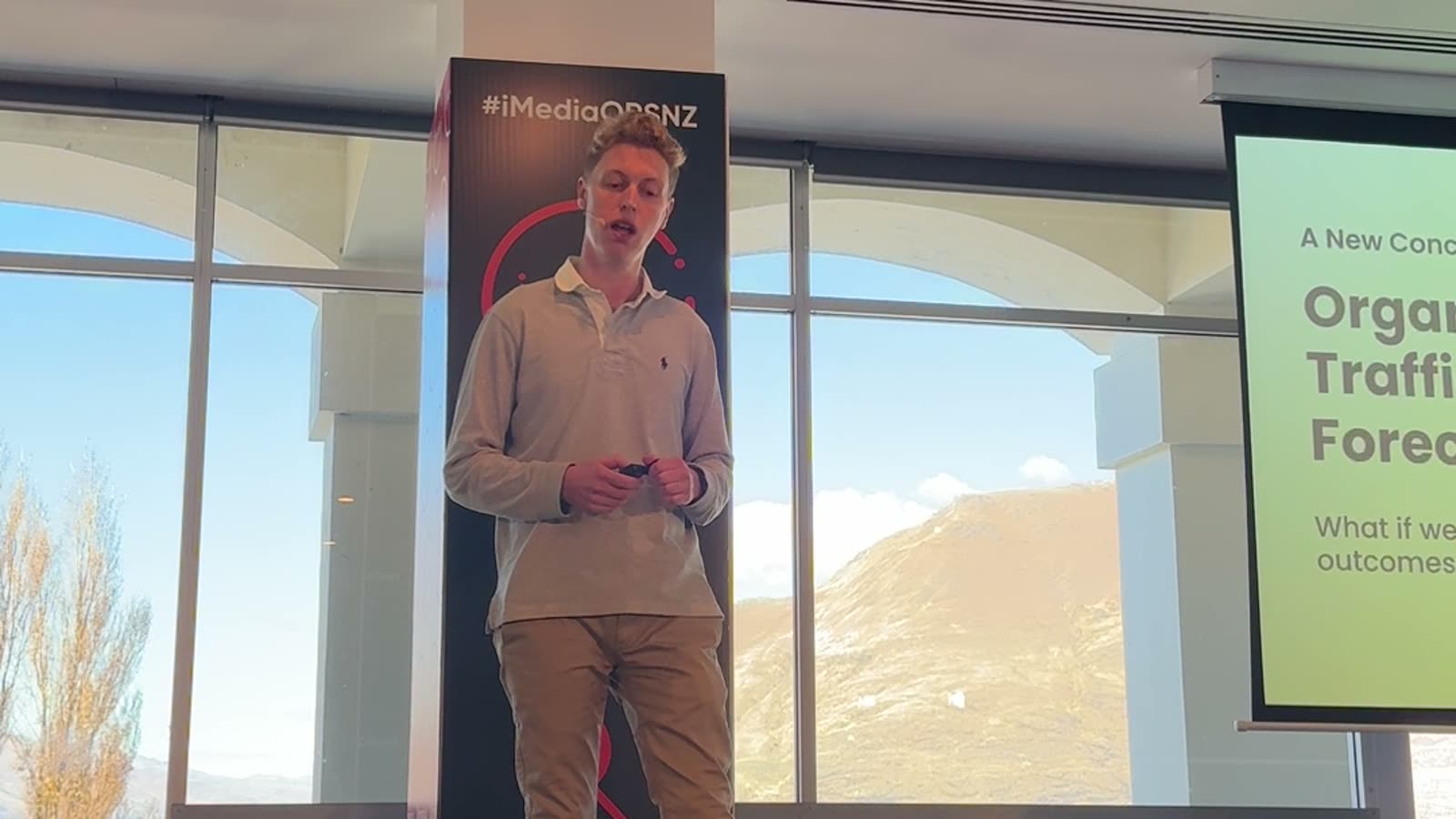
Ben McIntyre took this to iMedia on the Gold Coast on 23 April 2026, in front of a room of retail and ecommerce marketers. It covers the same four signals as the Queenstown talk, and the emphasis is different: more on digital PR, more on writing headings the way customers actually speak, and a closing argument about what separates the brands that will get this right.
The projector lost his deck for the first two minutes. He talked through it.
The short version
- Brand mentions have replaced backlinks. Digital PR is now the lever, and the gap between brands running real PR and brands running link building is large.
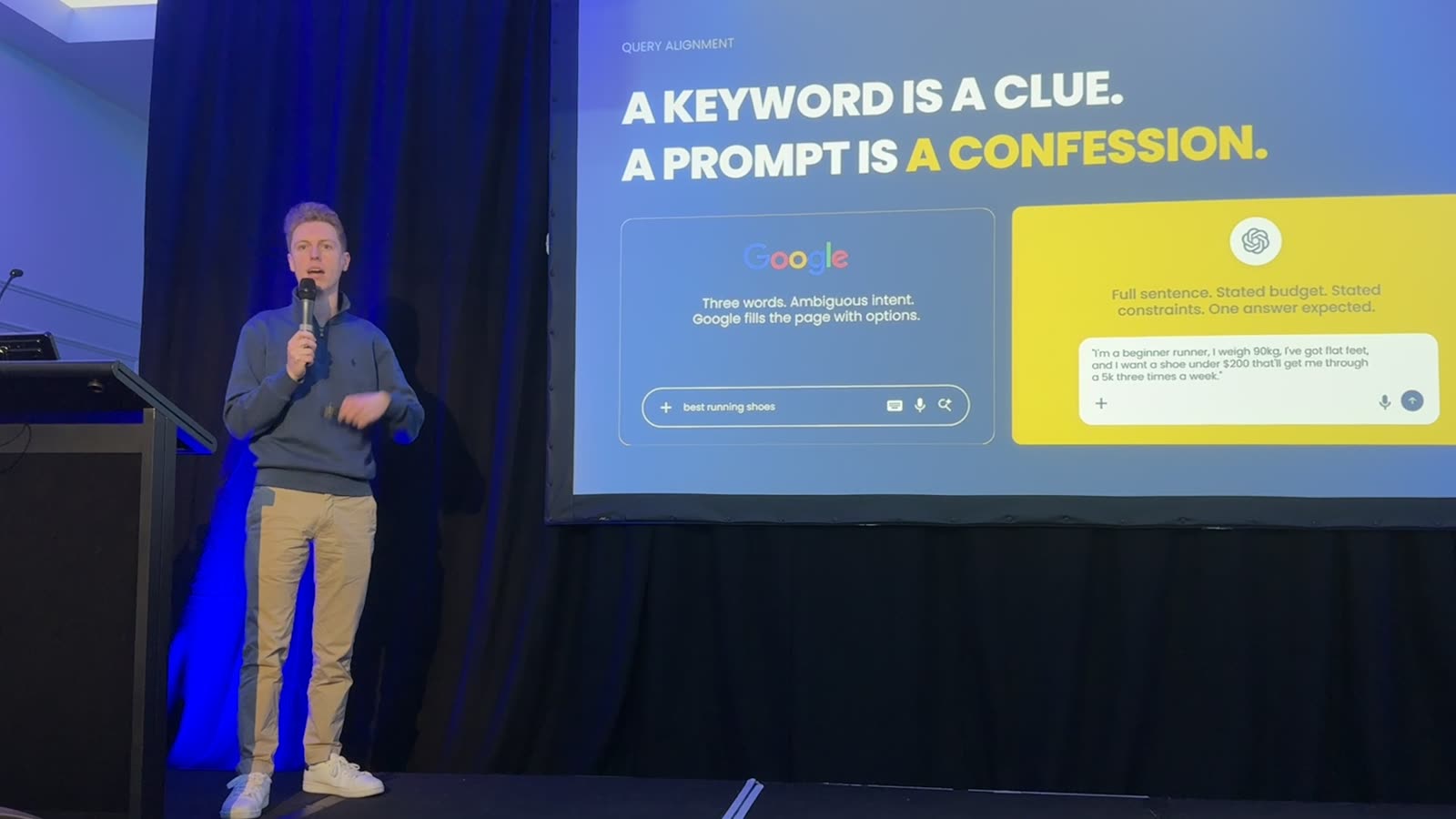
- A keyword is what people type into Google. A prompt is a full sentence with a budget, a constraint and a deadline in it. Your headings have to match the sentence.
- Being recommended needs two things at once: consensus with what every other credible source says, plus information gain that nobody else has.
- Cite your sources. Linking out raises trust here, and freshness signals like dates and timestamps matter.
- Most AI traffic is on desktop, after a decade of mobile-first work.
Why digital PR beats link building now
This is the part that is sharper here than in the Queenstown version.
ChatGPT is counting how often your brand appears across the internet: articles, podcasts, YouTube transcripts, Reddit threads, press releases, independent reviews. Every external mention is picked up. The do-follow versus no-follow debate, the anchor text work, the domain counting, none of that transfers.
Ben's point from speaking to large US PR agencies is that the gap is not marginal. Brands running significant branded PR are seeing an impact on AI visibility that brands running traditional link building are not getting at all.
Then the Matthew effect takes over. More mentions means more citations, more citations means ChatGPT surfaces you more, which produces more mentions. It compounds, and the brands that wait have a longer climb.
A prompt is not a keyword
In Google someone types "best running shoes".
In ChatGPT the same person writes: I am a beginner runner, I weigh 90kg, I have flat feet, I want a shoe under $200 that will get me through a 5k three times a week.
That is a prompt, not a keyword. And the more considered the purchase, the longer and more specific the prompt gets, which matters most for retailers with deep or complex ranges.
There is a second effect worth noticing. People who do not know what they are looking for are getting shown things they would never have found, which is something Google has never been especially good at.
The easiest win is the exact-match prompt. If a buyer asks for the best coffee machine for a small office, and your page carries that exact question with a real answer under it, you are the thing that can be surfaced. Ben's slide put it plainly: write your headings the way your customers actually talk. Pull the real questions out of your customer support systems.
Which means dropping the jargon. Best in class. Disruptive offerings. Seamless end-to-end solutions. Nobody prompts that way, so none of it gives the model anything to match.
Consensus plus information gain
Thin pages still get indexed by Google. ChatGPT will not necessarily pick them up at all, so depth matters more here than it does for traditional SEO.
To be recommended, content needs both halves:
Consensus. Whatever every other credible source says about the topic, you need to cover as well. Leave a gap and the model sees the gap.
Information gain. Something the other sources do not have. Proprietary data, your own testing, customer insight, your own take.
Say what everyone else says, and also say what nobody else has.
Cite your sources, and stop protecting authority
The technical foundations still apply in full. Crawlable, fast, properly structured, and not hidden behind JavaScript, because content the model cannot reach does not exist to it.
The reversal is on outbound links. Search marketing spent years being careful about linking out on the theory that it leaks authority. ChatGPT wants the opposite: it wants to see where your claims come from. Attribute research, put statistics against sources, and date your testing data, because freshness carries weight.
And 65% of AI traffic is arriving on desktop. Those visitors often come back across several sessions, so the desktop conversion flow deserves attention it has not had in a decade.
Why OpenAI keeps retreating to the model
Worth understanding before betting on any single ChatGPT feature.
OpenAI launched SearchGPT, launched their own crawlers, partnered with Bing, and started building ecommerce integrations and a native checkout. Every time they push into commerce, they pull back to the core model.
Ben's read on why: Google already owns the search ecosystem and can introduce ads at its own pace. For OpenAI, model superiority is the whole position, so the moment Gemini and Claude ship better models, everything goes back into the model. Anything you build on a specific feature is standing on ground that moves.
AI advertising is the change to plan for. It is already rolling out in the US. Once it opens up beyond selected retailers, the channel becomes properly transactional, because buyers will work out they can purchase there.
Curiosity is the competitive advantage in 2026
The closing argument, and the line worth keeping.
This is not really SEO any more. It is marketing: PR, social, video, the conversations happening on Reddit, whether customers are willing to say good things about you in public. All of it feeds the same machine.
You will not crack it in a week or in a quarter. The brands that start first get the head start, and trying things is the advantage.
Full transcript
Transcribed with Whisper large-v3-turbo and lightly cleaned. Filler sounds and stutters are removed, wording is otherwise unchanged. One transcription failure was recovered from a second pass and is marked inline; corrections are listed at the end.
Opening, and a slide that would not load [00:00]
[00:00] ...who is really thinking about AI search as a really important strategy, much greater number of people. Definitely AI search is now becoming the channel which of course everyone is starting to talk about, here yesterday in the first presentation. AI search is becoming that next channel which we really need to have a strategy for and think about.
[00:27] So, I'm hoping that my presentation will come up very shortly. I'm going through it and then retracting on half of the things that I've got slides for, but hopefully this will pop up.
[00:44] (From the host: "Why don't you tell us about your business and the intro.")
About Kia Ora Digital [00:47]
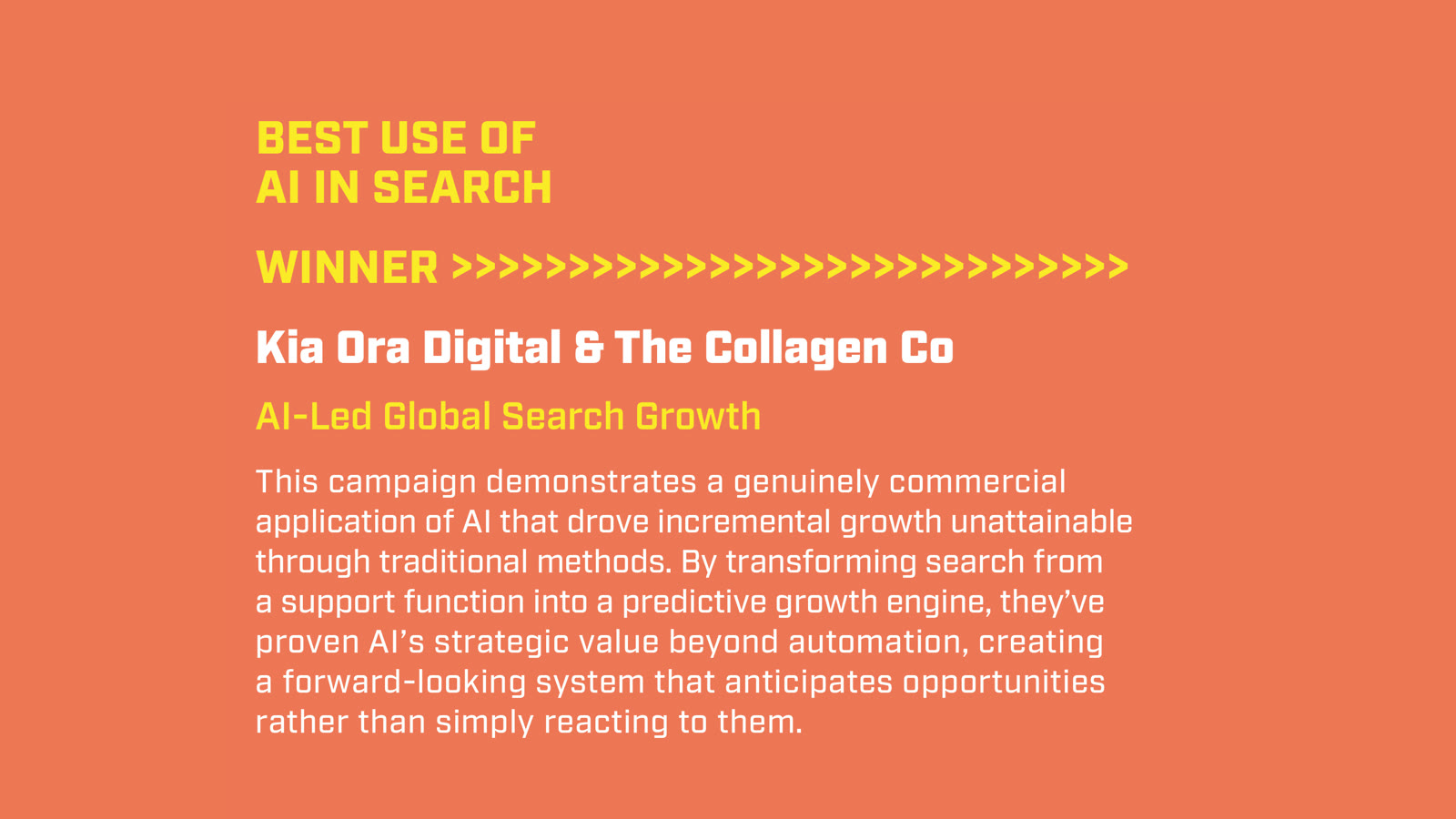
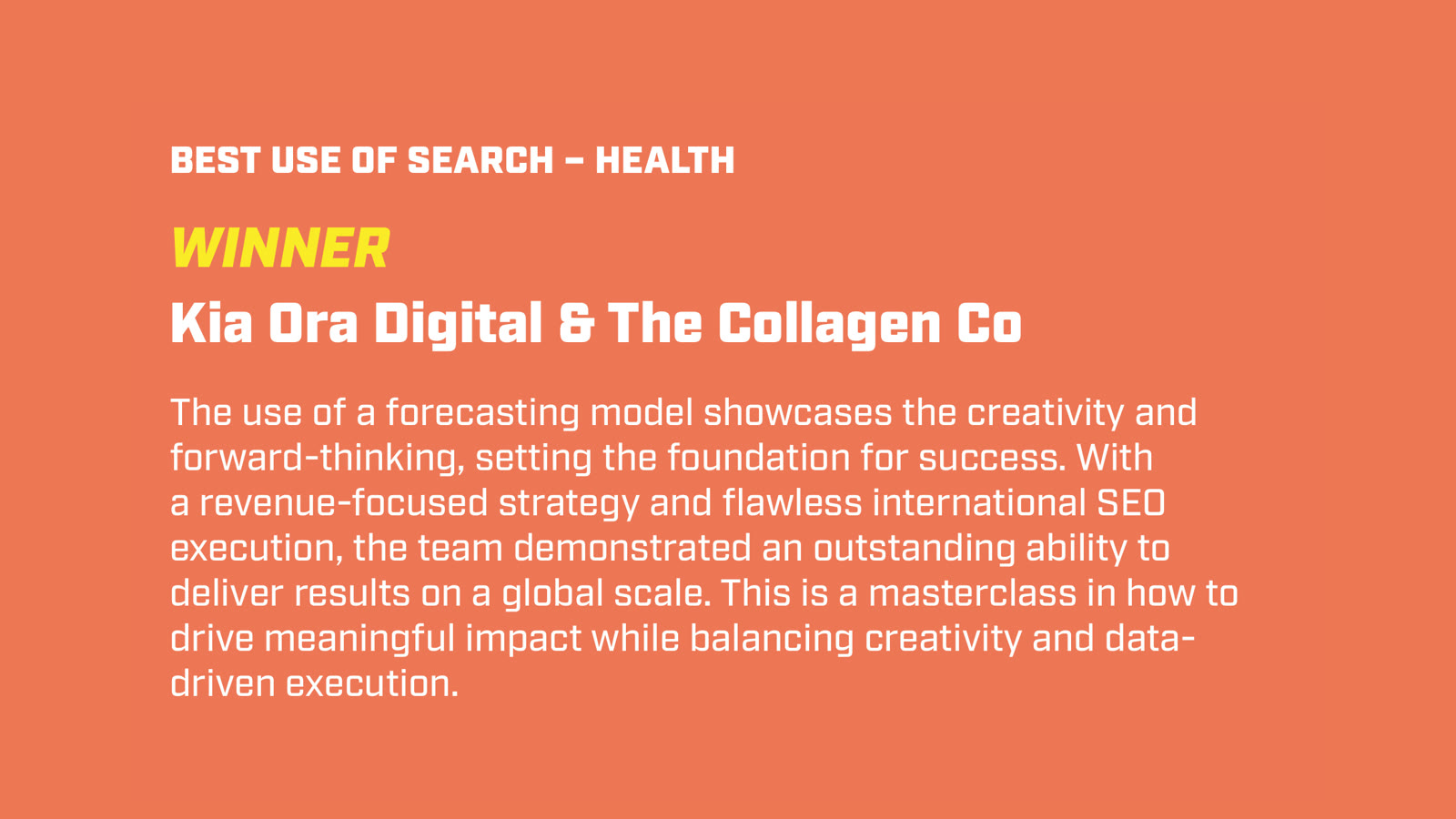
[00:48] So we are a global search agency, Kia Ora Digital is the name. I'm based in Queenstown in New Zealand. There's three founders. We were all originally from Queenstown. That was where we actually met. So our roots go back to Queenstown.
[01:04] We're now based across New Zealand, Australia. We've also got a partnering team in the UK, and I'm focused a lot now on the US market as well. Part of that is because of the fact that there's so much happening in the US, especially in AI. That is where all the new technology is coming from. That's where all the latest product announcements are. So that's been a big focus for us.
[01:28] But as a business, we've been really focused on e-commerce SEO and retail SEO for the past, coming on five years. We've turned five in October.
[01:37] And for us, we are trying to help merchants really understand the gap between how much revenue they're generating in a branded versus non-branded environment organically. What that's going to start to look like in the AI era as well, as AI overviews start to shape up the way that Google and so on presents the results.
[02:03] So there's a lot of change. I think at the moment, this is the single greatest change in search and maybe even in marketing, the way that AI is starting to really take shape. And it's also going to change customers and their purchase behaviours and buying decisions as well, as time goes on.
[02:22] So yeah, it looks like I've got a screen. Actually this is awesome. So we'll kick into this. I'm going to be a little short on time, sorry. If you don't mind just extending that screen on the bottom here slightly, that would be awesome.
The 87% number [02:37]
[02:37] So I've already done the intro, I won't go into it. I've already asked the question about who's got an AI search strategy, which we know.
[02:48] Now, 87%. This is a metric and a number that I really want everybody to think about. That is the share of AI search traffic that ChatGPT alone contributes out of all of the AI search channels, right?
[03:05] So that means that when we're talking about AI search, and how consumers are using and looking for products online, we really need to be thinking about ChatGPT as the primary channel.
[03:16] That's come from trusted source tracking over 75,000 page view, sorry, 75,000 sites over the last eight months, understanding how much traffic is coming from what LLM essentially. 87% is the metric.
[03:33] So, the other thing to really note is that ChatGPT has had 900% year on year growth in the last 12 months as well. Right? Which is massive. And of course, that is the channel that more and more consumers are starting to use.
[03:52] I know we as marketers and people in tech and so on, we probably use some of the other channels like Claude or Perplexity and whatnot. But ChatGPT, for everyday consumers who are going to be the ones who are going to start looking at your products, they are the ones that you need to be really focused on, and ChatGPT is the platform.
ChatGPT versus Google [04:12]
[04:12] So, this isn't Google versus other AI tools necessarily. It's a ChatGPT versus Google game, right?
[04:21] And when you're inside ChatGPT, the responses look quite different to Google, as we all know. There's no ads currently. There's no blue links. A whole lot of different options. There's no sidebar. There's no competitors necessarily that are trying to take ad space and compete on brand terms. None of that is happening right now. You've got complete freedom and opportunity. And so you really want to be the brand that can be recommended.
What ChatGPT can do with your brand [04:48]
[04:58] There's three key things.
[05:01] One is that it can cite you. This means that you show up as a reference inside ChatGPT. It might use you as part of its evidence, part of its thinking and reasoning. That's all very well and good, but you're purely just cited.
[05:14] The second thing is that it can actually mention you. So that means when it's provided a GPT response, it is saying, we recommend these brands or these businesses or these products and solutions for whatever the problem is that that user has searched for.
[05:31] And then the third thing, which is really what we want to be achieving, is being recommended, which is at the very bottom of its entire response. It's then saying, okay, we out of everything recommend this particular brand or product or service or whatever.
[05:49] So, the difference between ChatGPT and Google is that there is one answer, there's one verdict, and ultimately you want that to be your brand.
[06:02] Consumers used to go to Google and type in "best X for Y". They used to go through and look at different articles, look at different forums, try and make a consensus for themselves. That's not what's happening so much any more. Instead, you're getting a singular answer at the bottom of the result.
[06:23] And in fact, being recommended by ChatGPT could be considered as strong as a warm referral. So, if you've got ChatGPT recommending you as a business or as a brand or as your product, that could be as strong as a friend or somebody else telling them, "hey, I recommend this product."
Where the research comes from [06:46]
[06:54] So, we've been running a reasonably significant research project. One of our partners in the UK has got some deep, deep connections with the University of Aberdeen. And we've been doing some deep research over the last several months. It kicked off around October last year.
[07:10] And I've personally spent about 100 days on the road in the last year as well, going to conferences, meeting with industry leaders. We've been speaking to people at Google. There's OpenAI executives and team members. And we've been understanding what is actually driving the things that are contributing to the way that the AI models are working.
[07:32] And now what we're starting to do is actually a global research project, where we're collating information from a whole lot of brands. Part of the things you may have noticed is that we're offering the ChatGPT playbooks. And the purpose behind doing that is to actually just collate a whole lot of data and be able to run those playbooks and run that information on a quarterly basis.
[07:52] So what we're able to do is start to identify what are the key things that are changing. How are brands appearing? What's different from one quarter to the next? And what are the traffic gains and visibility changes?
The four signals [08:05]
[08:05] So let's get into the nitty gritty of actually what we're all interested in, which is how do you get your brand recommended in ChatGPT.
[08:15] So, four key buckets, which I'm going to talk about today. One, brand signals. Two, query alignment. Three, authority signals. And four, the technical factors. We'll take them one at a time.
Signal 1: Brand signals [08:29]
[08:29] So the first thing is why brand signals are the biggest growth lever in AI search. This is really important, and it's probably the thing that I want to stress the most.
[08:40] ChatGPT is looking at how often is your brand being mentioned across the internet. Your brand name can show up in so many different places. It can show up in articles and podcasts and YouTube transcripts and Reddit threads and press releases, independent reviews. Every time your brand is being mentioned by somebody else externally, that's a brand mention and it's getting picked up.
[09:06] For years, we've obsessed over what we call backlinks in the SEO world. How many domains linked to you? How many keyword anchors do you have? And you've got the do-follow versus no-follow debate. That doesn't necessarily matter with ChatGPT and AI search. They work differently.
[09:29] This is where digital PR starts to become invaluable, because having those brand mentions, especially on highly reputable sites, is what's key. And that's some of the insight that I learned from some of the largest PR agencies in the US last year. The impact that they're seeing with brands, large brands that are doing a significant amount of branded PR versus traditional link-building style work, is just enormous. There's a huge gap.
[10:02] So what's happening here is something called the Matthew effect, which is the rich get richer. The more that you're mentioned, the more you get cited. The more you get cited, the more ChatGPT surfaces you and mentions you. And so around it goes. When this occurs, there's a compounding effect.
[10:26] And so the more brand visibility that you can get, the better. And those that wait longer to do it, or don't do it as aggressively, will have a much longer time trying to catch up.
[10:40] So I think if there's one thing that I want you to take away from this, it's that brand mentions are the new backlinks. They're really, really important.
Signal 2: Query alignment [10:50]
[10:52] The way that people search in ChatGPT is completely different to the way that they search in Google. In Google, people type keywords. In ChatGPT, people prompt in full sentences with context.
[11:07] Here's an example. In Google, a user might search for "best running shoes", which provides Google a clue to what the buyer is looking for. But in ChatGPT, the user might prompt: "I'm a beginner runner. I weigh 90 kgs. I've got flat feet. I want a shoe under $200 that'll get me through a 5k run three times a week."
[11:27] That's a prompt, not a keyword.
[11:29] And if you're a bigger retailer with more complex products, expect your customers to prompt in even more depth. The more considered the purchase, the longer and the more specific the prompts will become.
[11:48] Which creates a new kind of demand. Because what actually happens here is that people who don't necessarily know what they're looking for are being surfaced new things. And that's something that Google hasn't traditionally been that great at doing.
[12:04] Write your headings the way that your customers actually talk. Your content needs to match exactly what people are prompting.
[12:12] If someone is asking ChatGPT for the best coffee machine for their small office, and your article has exactly that, "what's the best coffee machine for a small office?", then ChatGPT will surface that. Or it's more likely to. So those exact-match prompts are what is really key.
[12:32] Getting that information out of your customer support systems and so on, and understanding what customers are actually asking, is really key. Those headings need to look like the way that people talk, and not like what typical marketing jargon kind of has been.
The jargon problem [12:50]
[12:52] Marketing jargon. "Best in class" this. "Disruptive offerings." "Seamless end-to-end solutions." All those marketing jargon terms that we all love to write and say, you know, we do this and we do that. That is not necessarily what people are searching for.
[13:10] They are using plain, simple words. They're looking to understand the product, and you want ChatGPT to be able to digest that exactly the same way that consumers are looking for it.
[13:22] So, less marketing jargon and more plain, simple language.
Signal 3: Authority signals [13:28]
The following passage was destroyed by a transcription failure and recovered from a second pass. See the notes.
[13:28] Authority signals. Number three. This is really whether ChatGPT trusts your brand enough to keep you in the answer.
[13:36] Now let me explain what I mean by this. Thin pages can get indexed by Google. ChatGPT, on the other hand, isn't necessarily going to pick that up. Content depth is really important.
[13:47] So, to be recommended, your content needs two things.
[13:51] The first is what we call consensus. You need what everyone else is saying. If every other credible article on the internet is saying "look for these things", then you need to cover those things as well. Otherwise, ChatGPT will see a gap and it's not going to give you the consideration.
[14:09] The second is information gain. You need to add some things that those other sources and other articles don't have. Your own proprietary data, your own testing results, your own customer insights, your own take on something new.
[14:23] That is the trick. Consensus plus information gain. Bring those two together. You say what everyone else says, but you also say what nobody else has.
Signal 4: Technical foundations [14:36]
[14:36] Then there's the boring stuff for most, which is the technical foundations. My favourite, but other people's nightmare.
[14:45] This is the thing that most people typically skip, or most brands don't put as much time and energy into, but it is critically important. If ChatGPT can't crawl your site properly, or if your content is hidden behind JavaScript, then you're invisible and it doesn't matter.
[15:06] So, the basics still apply. Everything from an SEO standpoint is still there. Clean structure, fast load times, proper schema, all those things, really important.
[15:15] But there's a couple of things I do want to pull out.
[15:18] One, cite your sources. For a long time, we have always told clients, and worked in situations where we say, be very careful about linking out, having external links that link to other sites on your website, because this can leak authority, it can take users away from your site, and so on.
[15:38] ChatGPT actually wants the opposite. It wants to see where your content is coming from. Is it evidence-based? What are the links behind that as well?
[15:48] So, if you can actually cite more of your content and put stats around it, "this was found by X university, it was done in this research paper", or whatever, then that is really useful. And even if you're doing product testing data and so on, you can put dates and timestamps beside that as well. That's really key, because content freshness is massive.
[16:11] The second thing is that most AI traffic is coming from desktop, or at least 65% of it currently, which is actually quite massive. And so, we've spent a decade optimising for mobile, which is still important. But we also now have to consider the fact that there is a lot of desktop traffic that can be coming through ChatGPT especially.
[16:36] And those people are potentially coming back over several sessions. And so that's just ensuring that our conversion flows and that our site is actually optimised for desktop as well, is really important.
Reality check: ChatGPT is not settled [16:49]
[16:49] And before we close out, I want to do a quick reality check on a few things.
[16:53] ChatGPT is super powerful, but it's also not settled. This is a closed system. It's rapidly evolving, and it's still being figured out even by those that are building it.
[17:04] So let's just have a look at what happened with OpenAI in the last couple of years. They launched SearchGPT, which was their kind of version of search inside the ChatGPT interface. They then launched their own crawlers. They did partnerships with Bing. And they also started to build out some e-commerce integrations. They wanted to be able to build a native checkout. And that was all well and good.
[17:31] But every time they pushed into e-com, they've reverted back to the initial model. And that is because model superiority is really important for OpenAI.
[17:43] Google have the search world already encapsulated in their own ecosystem. They can slowly bring ads in and so on, that's fine. But when Gemini and Claude released better models than OpenAI has with ChatGPT, then everything has to go back into the model. That's where the focus is.
What's coming next [18:00]
[18:00] So what's coming next? AI advertising is coming. It's already starting to be released in the US. We do need to be super conscious of this.
[18:07] And as soon as it does start to roll out on more of a global stage, and in an open environment where it's not select retailers that have access to it, that is what's going to then start to make this channel much more transactional. We really need to be thinking about that, because buyers will start to realise that they can use it as a channel to buy.
[18:27] And the last thing before we wrap up is that this isn't necessarily SEO any more. It's actually all about marketing. Everything that happens on your site, PR, social, video, conversations on Reddit, whether it's customers that are happy to write about you publicly and recommend your product. That is what's really important.
[18:45] And so curiosity is the competitive advantage in 2026. Trying new things is really key. You won't crack it in a week. You won't crack it in a quarter. It's going to take time. But those that start first will have the head start.
Close [18:58]
[19:00] So, final things. Come and find me. We are offering free ChatGPT marketing playbooks, which is essentially a bespoke playbook designed for your brand. You're able to get a whole lot of insights, about 12 things in it. It has query prompts, a whole lot of interesting insight. That's key.
[19:16] And then also, if you'd like to connect with me, feel free to scan my QR code. You can add me on my handshake code, 52102. And I'd be really happy to talk further to anybody who wants to know more about AI search and ChatGPT marketing.
[19:31] Thanks for your time.
(End of recording, 19:43.)
Transcription notes
One significant failure, corrected. Between 13:27 and 13:42 Whisper produced a hallucination loop: the line "That's not necessarily what you're looking for." repeated fifteen times, replacing real speech. A second isolated pass over that window recovered the actual content, which is Ben introducing signal three, and it has been spliced back in above. A hallucination loop is silent, it reads as plausible English and nothing flags it. The full transcript was scanned for repeated lines and this was the only occurrence.
| Timestamp | Whisper heard | Corrected to | Basis |
|---|---|---|---|
| 12:12, 12:25 | "copy machine" | coffee machine | The slide on screen reads "coffee machine" |
| 00:48 | "Keogra Digital" | Kia Ora Digital | Known brand |
| 01:02 | "our route's back to Queenstown" | our roots go back to Queenstown | Homophone |
| 03:52 | "Claude or Complexity" | Claude or Perplexity | Known product |
| 07:39 | "we're offering is changing the United Playbooks" | we're offering the ChatGPT playbooks | Garbled, referent confirmed at 19:00 |
| 12:07 | "what people are compting" | what people are prompting | Garbled |
| 13:12 | "to be able to adjust that" | to digest that | Homophone |
| 14:17 | "your own tape on something new" | your own take on something new | Homophone |
| 17:52 | "when Gemini Claude released" | when Gemini and Claude released | Dropped word |
| 01:48 | "presents the startup" | presents the results | Reconstructed from context, low confidence |
The 87%, 900%, 75,000-sites and 65%-desktop figures were read off the slides. The University of Aberdeen partnership mentioned at 06:57 is what the audio says and has not been independently verified, so it is left in the transcript and out of the write-up above.